Solidarity Beyond Borders: Rethinking Peer-to-Peer Crop Insurance
Peer-to-peer (P2P) insurance is often pitched as a cure for an industry that policyholders distrust. For household, auto, or pet insurance, the pitch mostly holds up. For crop insurance, Peer-to-peer crop insurance runs into a wall that has nothing to do with technology and everything to do with physics: weather does not respect the boundary of a friend group.
This post covers, in order: what Peer-to-peer crop insurance is; why open-field agricultural risk is different from most other insurance risk; the three-layer risk transfer chain crop insurance actually runs on; why local P2P pools, the broker model, the carrier model, and the decentralized/DAO model each fail for crops; and why a Takaful-style, affinity-based model is the most credible way forward.
1. What P2P insurance is, and where it came from
Peer-to-peer insurance is a risk-sharing arrangement in which a group of people with a shared interest pools contributions to cover losses among themselves, instead of transferring all risk to a distant, shareholder-owned insurer. Wikipedia’s definition frames it as a reciprocity contract aimed at cutting overhead, improving transparency, and removing the conflict of interest between an insurer that keeps unclaimed premiums as profit and a policyholder who wants that premium paid out as a claim.
The idea is old. Roman collegia tenuiorum collected dues to pay for members’ funerals. Marine risk-pooling among merchants at Edward Lloyd’s Coffee House in the late 1600s became the Lloyd’s of London market. Friendly societies and agricultural mutuals ran on the same logic for centuries: members share the loss, so no single member is ruined by it.
The modern, tech-branded wave started with Friendsurance, founded in Berlin in 2011. Guevara (UK), PeerCover (New Zealand), and p2pprotect (France) followed with variations on the same idea. The “P2P” label in insurtech is mostly a rebranding of mutual and cooperative insurance principles with a digital front end, which matters here because agriculture is one of the oldest and hardest test cases for pooled risk.
NAIC and Wikipedia describe three recognized P2P models:
| Model | How it works | Examples |
| Broker | Broker aggregates policyholders into small groups; part of premium funds a group pool for minor claims, the rest goes to a licensed insurer for larger claims | Friendsurance, InsPeer, PeerCover |
| Carrier | The P2P provider is itself the licensed insurer; own capital and reinsurance cover claims beyond the pool | Lemonade, Guevara, První Klubová pojišťovna |
| Self-organizing / DAO | No intermediary; peers assess risk, set contributions, and vote on claims | TongJuBao’s early design, Teambrella |
2. Agricultural risk: why open farming is a harder problem
Agricultural risk splits into two categories, and conflating them is where a lot of insurance design goes wrong.
Idiosyncratic risk hits one farmer and not the neighbor: a barn fire, a broken pump, localized theft. This is what classical pooling is built for, because it is independent across policyholders, so the law of large numbers works.
Covariate (systemic) risk hits many farmers in the same area at once: drought, frost, flood, hail, a regional pest outbreak. Open-field farming is disproportionately exposed to this, because crops sit outdoors, exposed to weather, over large contiguous areas.
A World Bank study on managing agricultural production risk states that when weather is good or bad, it tends to affect all farms in an adjoining area similarly, and that the law of large numbers, on which premium and indemnity calculations are based, breaks down once losses are spatially correlated. Research using vine copula models on U.S. corn and soybean portfolios confirms the mechanism: geographic correlation drives systemic risk, so a portfolio of policies in one region does not diversify the way a portfolio of unrelated policies would.
This is the fault line that determines whether any P2P model can work for crops: every model below either accounts for that clustering or collapses because it doesn’t.
3. The three-layer risk transfer chain agricultural insurance runs on
Covariate risk can produce losses far beyond what any single premium pool can cover, so agricultural insurance is built as a chain:
- Insurance: a local or national insurer prices normal-year variability into premiums for individual farmers.
- Reinsurance: the insurer cedes part of its portfolio to a reinsurer with a larger, more diversified balance sheet, who can absorb a bad year in one country because it is offset elsewhere. These arrangements are typically structured as proportional treaties or non-proportional layers; the distinction between a stop-loss and an excess-of-loss trigger, aggregate loss ratio versus a single large loss, is explained in Zetarium’s stop-loss vs. excess-of-loss comparison.
- Retrocession: the reinsurer cedes part of what it holds to a retrocessionaire, spreading catastrophic, tail-end losses across the global reinsurance and capital markets.
The logic mirrors property catastrophe risk generally: primary insurers absorb frequent, moderate losses; reinsurers absorb the low-probability, high-severity “peak risk”; retrocession diversifies what reinsurers cannot hold alone. Specialist literature on agricultural risk transfer frames this chain as taking farm-level catastrophic exposure out of local areas and into global markets, exactly what a smallholder or single-region pool cannot replicate.
Insurance and reinsurance alone are only sufficient for normal-year variability. Retrocession exists specifically for the catastrophic tail, the tail a drought or frost event represents for open-field agriculture. A crop insurance model that skips this layer is implicitly betting that catastrophic, correlated loss won’t happen.
4. Why local, family-and-friends P2P pools are structurally meaningless for crop risk
In most insurance lines, a family-and-friends pool works because members’ risks are close to independent. Your neighbor’s car accident doesn’t make yours more likely.
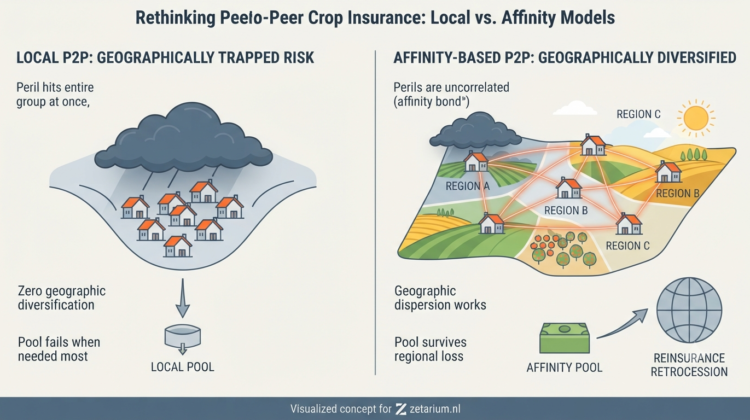
Crop risk breaks that assumption. Family and friends in agricultural communities are, almost by definition, geographically concentrated: the same valley, watershed, or microclimate. This closeness is what a local P2P pool relies on for trust, and it is exactly what produces correlated exposure to the same peril. When drought or frost hits a plain, it doesn’t select one household out of the group; it hits the whole plain, and therefore the whole pool, at once.
A local P2P pool cannot redistribute crop risk, because redistribution needs some members unaffected while others claim. If a peril hits everyone simultaneously, there is no unaffected side of the ledger. The pool fails exactly when it is needed most: a structural property of geographically clustered pools, not a fixable design flaw.
The broker model doesn’t solve this. It keeps minor claims inside a group fund and pushes larger claims to an insurer behind it, which works when the “minor claims” layer is genuinely idiosyncratic (a car dent, a broken screen). Weather-driven crop losses rarely have that idiosyncratic layer at all: a drought-affected plain produces the same large claim from every member at once, not a handful of small independent ones a friend-group fund can absorb.
5. The carrier model: a track record of failure worth taking seriously
The carrier model, where the P2P provider is itself the insurer, has been tried repeatedly outside agriculture.
Guevara (UK, car insurance) launched in 2014, split premiums between a “protection pool” and a shared pot, and shut down in September 2017, stating it had failed to establish a fully capitalized underwriting vehicle. Verdict’s analysis argued Guevara picked the wrong market: car insurance is a commodity line dominated by trusted incumbents, and P2P works better offering niche coverage than competing head-on with cheap, well-capitalized mainstream insurers. No insurtech “unicorn,” however well-funded, can progress without buy-in from incumbent capacity providers; ideas have to win industry and regulatory acceptance, not just customer enthusiasm.
InsPeer (France) narrowed its ambition to sharing the deductible layer of existing policies among friend groups. Agency Nation’s review of P2P insurtech raised a structural criticism that applies to any small, socially bonded pool: P2P models rely on members voluntarily under-reporting small claims out of solidarity, an assumption that is optimistic at best, given how material insurance fraud already is across conventional lines.
The broader pattern holds beyond these examples. Coverager’s retrospective of insurtech failures lists Guevara among 21 startups that “didn’t quite make it,” despite venture backing that, in theory, should have improved its odds. An A.M. Best analyst quoted in Risk Management Magazine noted in 2017 that P2P insurers were often reluctant to disclose market share or premium data, making it hard for rating agencies to assess whether the model worked anywhere at scale.
Three causes recur: undercapitalized underwriting vehicles that couldn’t absorb a bad year; commodity markets where incumbents already offered lower prices and higher trust; and solidarity assumptions that don’t hold under real financial pressure. All three are worse in crop insurance. Agricultural catastrophe losses are larger and more correlated than an auto claim; incumbents already rely on state subsidy and reinsurance a startup carrier can’t replicate; and asking farmers hit by the same drought to under-claim out of solidarity isn’t realistic when a livelihood, not a subscription, is on the line.
6. Why the decentralized, self-organizing (DAO) model fails on competence, not just capital
The self-organizing model removes the intermediary altogether: peers price risk, set contributions, and vote on claims. In its current form, this is essentially a DAO (decentralized autonomous organization / decentralized administration) applied to insurance: governance and claims decisions run through member votes and coded rules rather than an insurer’s underwriting department. For crop insurance, this is a competence problem before it’s a capital problem.
Pricing agricultural risk requires actuarial modeling of yield distributions, spatial correlation, and tail dependence between regions. Frontiers in Environmental Science’s review of copula-based models for crop insurance and reinsurance under systemic risk uses vine copula models specifically to capture the asymmetric, non-linear ways regional crop losses move together, and treats this as genuinely hard even for professional actuaries with decades of yield data.
Ordinary farmers, however experienced at farming, are not positioned to price this, and generally have no visibility into conditions in other regions whose correlation with their own would need to be known to price a pool correctly. A DAO-style vote substitutes local judgment for actuarial modeling exactly where actuarial modeling is hardest to do without formal tools.
There is a supply-side problem too. Professional risk traders (reinsurers, ILS funds, catastrophe bond investors) generally take on agricultural risk, but price it carefully around the catastrophic tail using the reinsurance-retrocession chain from Section 3. What they avoid is informally structured, decentralized crop pools lacking underwriting discipline, transparent loss data, and a clear mechanism for laying off the catastrophic layer. Without that capital behind it, a DAO-style pool has no backstop once losses exceed member contributions, precisely the covariate-risk scenario that matters most.
7. The paradox at the center of P2P crop insurance
So far, we concluded that without a multi-layer risk transfer structure behind it, P2P crop insurance is not financially viable because covariate risk will eventually exceed what any pool can self-fund.
That creates a second, conceptual problem. P2P insurance is defined as distinct from ordinary insurance by its community-based character: people bound by a shared identity, supporting each other through disaster, rather than buying a product from a distant underwriter. Bolt a multi-layer risk-transfer structure onto a local community pool, and that community becomes, from the reinsurer’s point of view, just one insured portfolio segment. The solidarity that defined “peer-to-peer” dissolves into a retail product with a community-branded front end. Keeping the local, small-group version of P2P and adding the risk transfer chain crop insurance requires are not simultaneously possible; one has to give.
8. The escape route: expand the definition of community past geography
The way out is to stop defining “community” by locality and define it instead by shared identity unrelated to which valley someone farms in: faith, culture, guild, or profession. If a P2P pool is organized around a religious or cultural affiliation shared by farmers scattered across many regions, the members’ underlying crop risks are no longer correlated with each other the way a local pool’s are. A drought in one region doesn’t generally coincide with a drought affecting co-religionists farming in an entirely different climate zone hundreds of kilometers away. This is the same geographic-diversification logic that makes reinsurance work, applied at the level of pool membership itself.
This still requires a centralized organizing entity, something closer to the carrier model, to recruit members, administer contributions, verify claims, and manage the fund across a membership too dispersed to self-administer. The difference from a conventional carrier is that membership is organized by affinity, not “anyone who buys this policy,” which preserves some of the original mutual-aid motivation even as the pool diversifies geographically.
International Solidarity Beyond Borders Enters the Stage
Community doesn’t have to mean a faith group specifically. A cereal-growers’ guild or association spanning several growing regions, a cooperative federation of dairy farmers, or a network of small rural communities of a few hundred residents each, linked across different watersheds rather than within one, can serve the same diversifying function, provided membership spans enough distinct climate and geographic zones.
Community doesn’t have to mean a faith group specifically.
Caution: a “community” defined as the residents of one village of under 500 people is not automatically diversified just because it carries a non-insurance identity. It is still one location exposed to one weather system. Whether any proposed community actually reduces correlated exposure has to be verified with the same risk-based, spatial-correlation computation from Sections 2 and 6, not assumed from the community’s social label. An affinity label only becomes useful once that correlation has actually been checked and found to be low across the group’s geographic footprint.
Takaful as a working example
Takaful is the clearest working example of a non-local affinity pool. It is a Shariah-compliant, mutual risk-sharing structure built on the Islamic principles of ta’awun (mutual assistance) and tabarru’ (a mutual donation into a shared fund), designed as a cooperative alternative to conventional insurance, which many Muslims consider incompatible with prohibitions on riba (usury, i.e., interest) and excessive uncertainty. Its members are bound by shared faith rather than geography, which is exactly what makes it structurally different from a local family-and-friends pool.
Existing Examples of Takaful
Concrete cases already operate in the crop-risk space this post is concerned with:
| Program | Location | What it does |
| Takaful Insurance of Africa | Kenya | Kenya’s first Shariah-compliant insurer (2011); index-based livestock cover for pastoralists, part of ICMIF’s “5-5-5” strategy targeting five million previously uninsured households across five countries |
| Salaam Takaful | Pakistan | Parametric crop insurance expanded after the 2022 floods, partnered with Syngenta; farmers contribute roughly $5/acre/year against payouts of around $18/acre if a weather metric triggers |
| Mutual weather-index pilot | Nigeria | Research collaboration with the Nigerian Agricultural Insurance Corporation and NIRSAL, testing whether Shariah-compliant structuring lifts uptake among roughly 15 million smallholders |
| Paddy Crop Takaful | Malaysia | Agrobank public-private scheme, presented alongside Spain’s AgroSeguro public-private pooling model |
The UNDP’s Insurance and Risk Finance Facility frames Takaful as a tool for climate-vulnerable Muslim-majority populations otherwise severely underinsured, noting that Indonesia, Pakistan, Bangladesh, Nigeria, and Egypt together hold roughly a billion people with under 2% insurance penetration, and names crop and livestock risk transfer a priority precisely because it can pair with sovereign-level risk transfer and reinsurance rather than replace it.
A related UNDP initiative targets financial resilience for 100 million people by 2030 through this route. In Nigeria specifically, a proposed model integrating Salam (forward-sale agricultural contracts) with micro-Takaful and value-chain financing, described in Islamic Economic Studies, targets the same underlying problem: giving smallholder farmers financing and risk cover through a community-based, Shariah-compliant structure rather than a purely local one.
Why does Takaful work?
Takaful works, where it works, because it doesn’t try to avoid the insurance-reinsurance-retrocession chain from Section 3; several of the cases above explicitly combine Takaful structuring with conventional index insurance, reinsurance backing, or public-private pooling. What it changes is the membership logic underneath that chain: contributors are bound by faith and mutual obligation rather than shared postcode, so the pool is geographically diversified from formation, and the solidarity character of “peer-to-peer” survives being combined with professional risk transfer.
It’s worth being explicit about when reinsurance and retrocession actually start to matter here. At small scale, a single-region Takaful fund faces the same covariate-risk exposure as any other local pool; expanding the definition of community only helps once the pool has genuinely grown across enough independent climate zones that its aggregate loss profile is no longer dominated by one region’s weather. Once that larger, diversified pool exists, reinsurance and retrocession become meaningful in the same way they are for a conventional insurer: a Takaful operator can cede risk to a retakaful operator, but general (conventional) reinsurers can equally participate in this risk transfer, either by reinsuring the Takaful fund under a Shariah-compatible structure or by taking a retrocession layer above it. The Shariah-compliance requirement changes the contractual form of the risk transfer, not whether professional reinsurance capital is needed.
9. What this means for a crop P2P model
A viable Peer-to-peer crop insurance model has to satisfy two conditions in tension by separating membership logic from risk transfer logic.
- Membership logic should be affinity-based and deliberately non-local: a faith community, a cultural diaspora, a cereal-growers’ guild, or a professional association spanning multiple climate zones. This keeps members’ perils uncorrelated enough for pooling to mean something, and preserves the solidarity motive that distinguishes P2P from a plain retail policy. The affinity label itself proves nothing; correlation across the group’s actual geographic footprint still has to be computed and verified.
- Risk transfer logic should still run through the full insurance-reinsurance-retrocession chain, exactly as conventional agricultural insurance does, so the catastrophic tail is absorbed by professional capital rather than the community itself. The community’s role is contribution, mutual verification, and absorbing normal-year variability, not underwriting catastrophe alone.
A carrier-style organizing entity is still required to administer this, recruit and vet members, and interface with reinsurers and retrocessionaires, whether Shariah-compliant retakaful providers or general reinsurers. Its legitimacy comes from being embedded in and accountable to the affinity community it serves, along Takaful lines, rather than from competing on price against subsidized incumbents, the trap Guevara and its peers fell into outside agriculture.